The American Economy Is Leveraged to a Leaderboard
Kimi K3 didn't erase America's AI lead. It priced how much of current US growth rests on seven stocks and one story holding.
Originally published elsewhere.
Kimi K3, the open-weight price war, and the one bet holding up US growth.
Moonshot AI is worth about $20 billion. Its reported annual recurring revenue is around $200 million. By the standards of this industry, it is a rounding error.
On Thursday 16 July, the Beijing lab released Kimi K3. Within hours it was ranked number one on a popular coding leaderboard. Within a day, Axios was running the headline “China just erased America’s AI lead”. Within four days, the White House was fighting internally over whether to ban Chinese models, the Nasdaq had sold off, and Microsoft was reportedly testing K3 as a replacement for OpenAI and Anthropic workloads inside Copilot.
That is a lot of consequence for a company one fiftieth the size of the labs it frightened. It is worth being precise about what actually happened, because the panic is only half right. The half it gets wrong is about the model. The half it gets right is about the American economy, and that half is worse than the coverage suggests.
What actually shipped
Kimi K3 is a 2.8 trillion parameter mixture-of-experts model. It activates 16 of its 896 experts per token, roughly 1.8 per cent of the network. It has a one million token context window, native vision, and an always-on reasoning mode. The full weights are due on 27 July under a modified MIT licence, which will make it the largest openly available model in history.
The launch result everyone quoted came from Arena’s Frontend Code leaderboard, where developers vote blind between two anonymous outputs on the same task. K3 scored 1,679 points. Claude Fable 5 sat at 1,631, GPT-5.6 Sol at 1,618. K3’s predecessor was eighteenth on the same board a generation ago. Seventeen places in one release is genuinely startling.
Demand hit so hard that Moonshot paused new subscriptions to protect capacity for existing users. American commentators found this exotic. A company refusing money to preserve the user experience is not standard practice here.
Now the part the headlines skipped. A preference leaderboard measures which output humans like more on front-end tasks. That is a real signal. It is not “the AI lead”. On Artificial Analysis’s independent composite index, K3 scores 57 against Fable 5’s 60, a close third or fourth overall depending on the board you check. On FrontierMath Tier 4, the hardest expert-level mathematics benchmark going, K3 lands around 39 per cent where the top American models score close to 90. Moonshot’s own technical blog concedes K3 sits behind Fable 5 and GPT-5.6 Sol on overall performance. And until 27 July nobody outside Moonshot has run the weights. The independent numbers that exist come from black-box tests of Moonshot’s own hosted endpoint; nothing can be reproduced, inspected or self-hosted until the artefact actually ships.
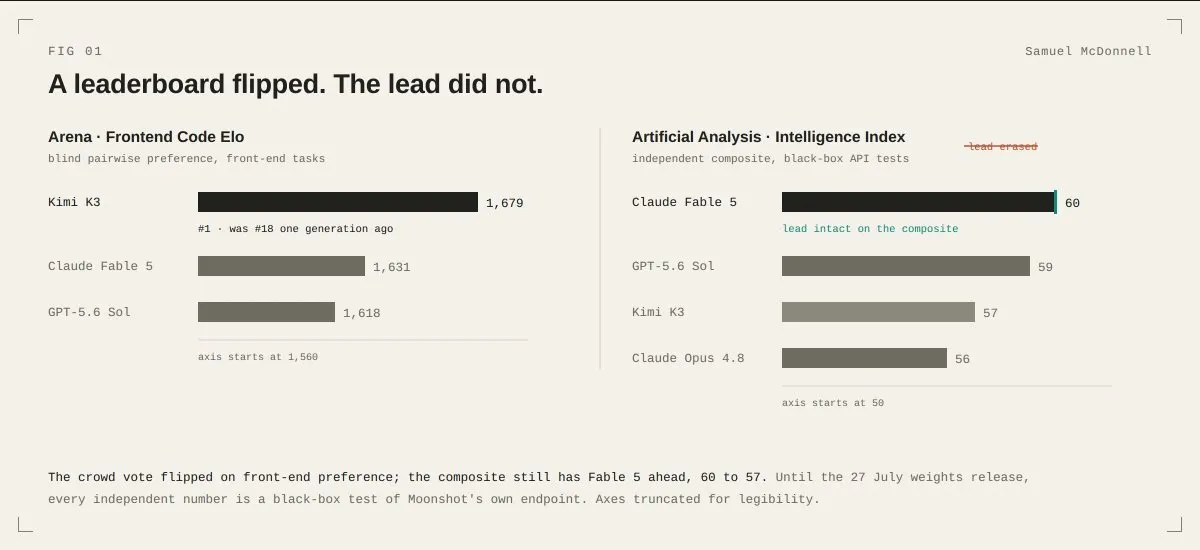
So the lead was not erased. A leaderboard flipped.
Those are different sentences, and the gap between them moved markets and moved Washington before independent verification was possible. Even the Axios article underneath the Axios headline was more careful, conceding the model does not need to be the world’s best to upend the market. The headline is what travelled. I have argued before that an eval is not a leaderboard. I did not expect the counterexample to arrive with a White House policy fight attached.
Be clear about what is real, though. K3 is the strongest open model ever released. It wins on long-horizon coding endurance and agentic browsing benchmarks. It is frontier-adjacent, built with a fraction of the compute available to American labs. Bank of America’s analysts made the point directly: denied top-end chips, Moonshot got there on training and architecture efficiency instead. The progress is not hype. The framing is.
The civil war in Washington
Per Axios’s reporting on 20 July, the administration is weighing Entity List designations for Chinese labs, federal procurement restrictions, security advisories and liability rules for companies that use Chinese models. A clean ban was considered before and shelved over fears of stifling innovation. With Sriram Krishnan gone from the White House, the officials who want restrictions have gained ground.
David Sacks, still advising from outside, is publicly against it. His argument: the closed labs are a duopoly on model revenue, and they want the government to remove their open-source competition for them. Then OpenAI made his point for him. Dean Ball, a former Trump administration official now at OpenAI, published a long essay lamenting that China is giving away models so good that for-profit labs may struggle to compete. Sacks asked whether Ball was confessing to a regulatory capture strategy or merely predicting one.
Strip the personalities and the shape is simple. Per Axios, proposals to ban open models have reached the administration from top AI companies or allies close to them. OpenAI’s policy voice is on the record lamenting the competition. Anthropic’s head of national security policy has publicly put America’s lead at about six to nine months. Two companies valued near a trillion dollars each stand to gain a protected home market from a ban on a free download. Whatever the security merits, that is the shape of it.
The price war Chamath half-described
Chamath Palihapitiya’s viral framing: American closed models cost $26 to 56 per million tokens, Chinese open ones cost 50 cents to a dollar, and forcing US companies to pay 50 to 100 times more than competitors abroad will impair them and crater the market.
The direction is right. The ladder is wrong, and the wrongness matters.
K3 is not the 50 cent tier. It costs $3 per million input tokens and $15 per million output, the most expensive model any Chinese lab has shipped. Claude Fable 5’s output price is $50, so the real gap at the frontier is roughly three times, not fifty. Axios’s much-quoted 40 per cent discount is real too; it is anchored to Opus 4.8 rather than Fable. Different rungs, both true. 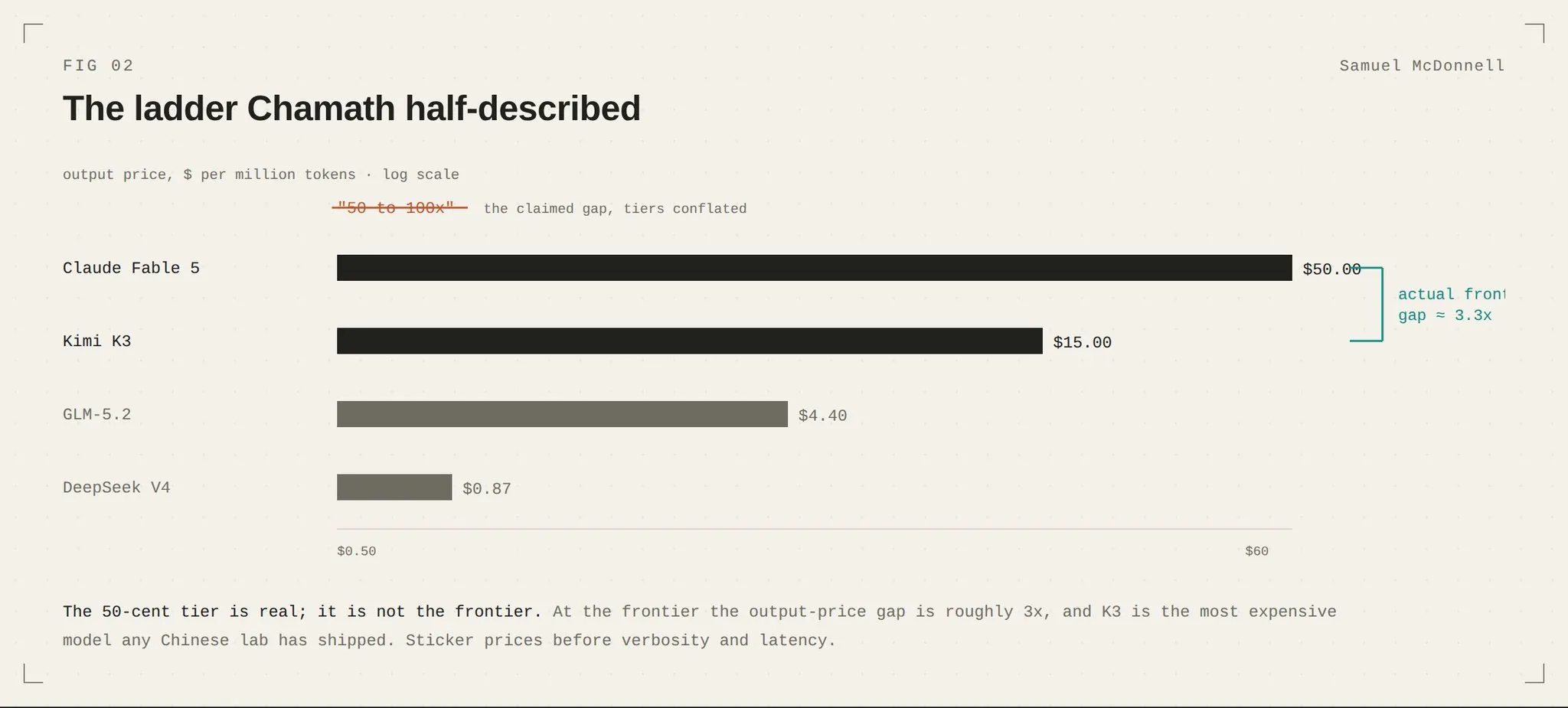
The 50 cent tier is DeepSeek V4 at $0.87 per million output tokens, which is excellent and is not frontier. And sticker prices are the start of the calculation, not the end. Early testing has K3 running roughly twice as verbose as its peers, with first-token latency near 34 seconds. I route model workloads for a living. Per task, the effective gap is narrower than the pricing page suggests.
Here is the number that should worry the labs more than any tweet. On OpenRouter, a marketplace that routes token traffic for a large slice of the developer market, the top five models by usage are all Chinese, and roughly 45 per cent of tracked tokens now flow through Chinese models. To be fair to the sample: OpenRouter sees only what is routed through it, which is cost-sensitive, developer-heavy traffic, blind to the direct enterprise pipes into OpenAI and Anthropic. But that selection effect cuts the argument’s way. The cost-sensitive segment is where commoditisation always shows up first.
Commoditisation does not arrive as one dramatic switch. It arrives through routing. Microsoft is reportedly adding K3 to Azure and evaluating whether it can power Copilot features that currently run on OpenAI and Anthropic models, with reported savings in the hundreds of millions of dollars, per The Information. Microsoft owns a large stake in OpenAI. It is testing the replacement anyway. Copilot is becoming a router, and routers send each workload to the cheapest model that clears the quality bar. The frontier keeps the hard 20 per cent of tasks. The margin was in the easy 80.
How this breaks the American economy
Set the geopolitics aside entirely and look at what this margin story is pointed at.
Start with the index. The Magnificent Seven are 32.5 per cent of the S&P 500 as of July 2026, about $22 trillion of market value, led by Nvidia at roughly $5 trillion. It is the heaviest seven-stock concentration in the index’s modern history, with the top ten near 40 per cent. Anyone holding a passive tracker has a third of their money on AI-adjacent mega-caps, whether they chose that or not. Three years of index gains have substantially been these seven names re-rating on a single story.
Then the real economy. In the BEA’s advance estimate for the first quarter of 2026, investment in computer equipment and software contributed about 1.09 percentage points of the 2.0 per cent annualised growth print, since revised to 2.1. The entire household consumption sector, roughly 68 per cent of the economy, contributed 1.08. One investment cycle is matching the whole American consumer.
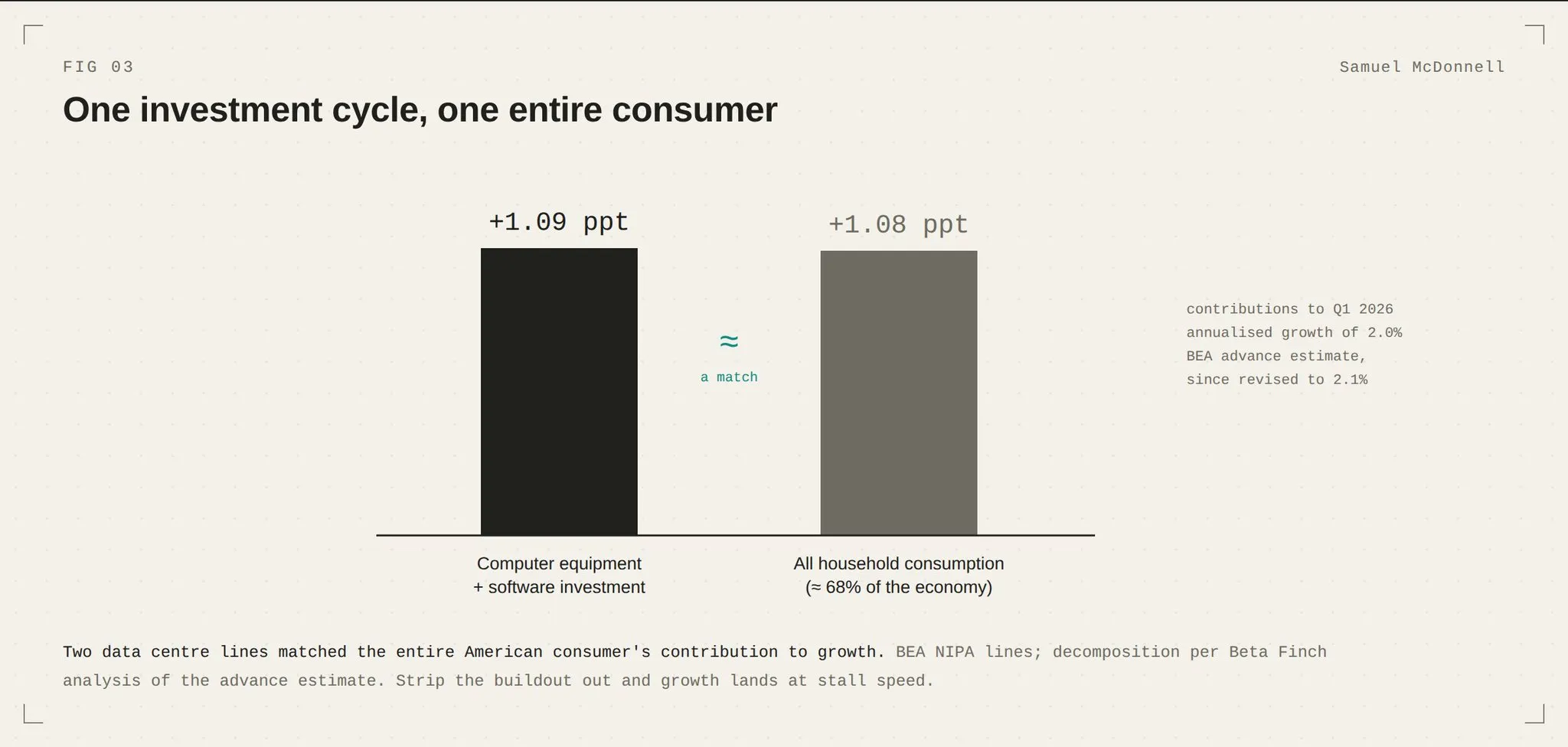
Analyst estimates put AI-related investment at as much as three quarters of the quarter’s growth; the BEA publishes no line item called AI, so hold the precision loosely. But strip the buildout out and US growth lands somewhere between half a point and one. Stall speed, before counting the construction and power spend that sits outside those two lines. Hold both truths at once, because both are needed: as a share of what the economy is, the buildout remains small, around 1.5 per cent of GDP on Epoch AI’s measure; as a share of how the economy grows, it is dominant. The level is the reassuring number. The flow is the exposure.
The spend keeps rising. The four big hyperscalers guided to as much as $630 billion of capital expenditure for 2026, up more than 60 per cent on last year’s record, and TrendForce’s May revision puts the top nine cloud providers near $830 billion. Nvidia talks about $3 to 4 trillion of AI capex by 2030. Most of it is underwritten by one assumption: that the intelligence sold off this infrastructure earns software margins. Even the share built for internal products, Meta’s ranking systems, Google’s search, is capitalised in share prices as AI-driven earnings. Same bet, different jersey.
One correction to the podcast version of this story. The fragility is not lab debt. OpenAI and Anthropic are overwhelmingly equity-funded, and their revenue is far larger than the commentary implies. Anthropic raised $65 billion in May at a $965 billion valuation, on annualised revenue that has gone from about $9 billion at the end of 2025 to north of $44 billion. OpenAI raised $122 billion in March and is marked between $852 and 920 billion, on roughly $25 billion of annualised revenue and, per The Information, an operating margin near minus 122 per cent. The leverage lives downstream, and it is no longer small. Hyperscalers issued about $121 billion of bonds in 2025, more than four times their five-year average. Oracle, Meta, xAI and CoreWeave have pushed over $120 billion of data centre spending off balance sheet into special purpose vehicles funded by Pimco, BlackRock, Apollo, Blue Owl and JPMorgan, per the FT. CoreWeave carries roughly $29 billion of liabilities against $3.9 billion of equity, much of it collateralised by depreciating GPUs. OpenAI has reported infrastructure commitments of about $1.15 trillion stretching to 2035. If model margins compress, the stress surfaces first in this credit, not in a lab’s P&L.
And the timing is exquisite. Both labs filed confidential S-1s in June, OpenAI announcing its filing on the grounds that it expected it to leak anyway. Nearly two trillion dollars of AI lab paper is headed for public markets this year, and SpaceX, which absorbed xAI, has already jumped, pricing the largest IPO in history in June at a debut valuation around $1.75 trillion. The comfort that “they are private, so they cannot drag public markets” expires the day they list. Not through index mechanics; neither lab would enter the S&P 500 at listing, since inclusion requires profits. The channel is blunter. A public mark on a negative-margin token seller reprices every private AI holding and every hyperscaler multiple leaning on the same assumption. The commoditisation question and the concentration question are about to become the same question.
So, the transmission chain, spelled out. Open-weight competition erodes frontier pricing power. Eroded pricing power breaks the return maths on the capex. Broken return maths disciplines hyperscaler spending. Disciplined spending removes the growth points currently carrying GDP, with a flat consumer behind it. A growth scare plus an earnings derate hits an index where seven names are a third of the weight, right as two negative-margin token sellers attempt trillion-dollar listings, while the credit that financed the data centres reprices underneath.
Every link in that chain is contestable. One of them is no longer hypothetical. In the second quarter, investors demanded higher yields on more than $14 billion of Oracle-backed data centre debt, and PIMCO sold down holdings. The last link has started moving before the others.
And be honest about the precedent, because it cuts against the chain. The DeepSeek scare of January 2025 knocked almost $600 billion off Nvidia in a single session, the largest one-day loss in market history, and then fully retraced within weeks. This chain has been tested once, and the market shrugged. What differs now is everything stacked on top since: eighteen more months of capex, a heavier index, far more credit, and an IPO channel about to open. Whether the reflex works a second time, with all of that weight on it, is the actual trillion-dollar question.
The rest of the honest counter-case deserves its paragraph too. Ben Thompson’s read is that demand is so overheated the American labs keep pricing power for now, because Chinese models cannot yet wage a price war at genuinely equivalent performance. Compute is supply-constrained everywhere; Moonshot could not even keep subscriptions open. Cheaper tokens plausibly expand total usage rather than shrinking revenue, the Jevons argument. And data centre demand can stay strong even if lab margins do not, since somebody has to serve the tokens either way. All fair. But notice what the bull case now requires: not that America stays ahead, but that the gap stays wide enough, for long enough, to justify nearly a trillion dollars a year of infrastructure at software-margin returns. That is a much narrower claim than the one the market has priced.
The war already ran the experiment
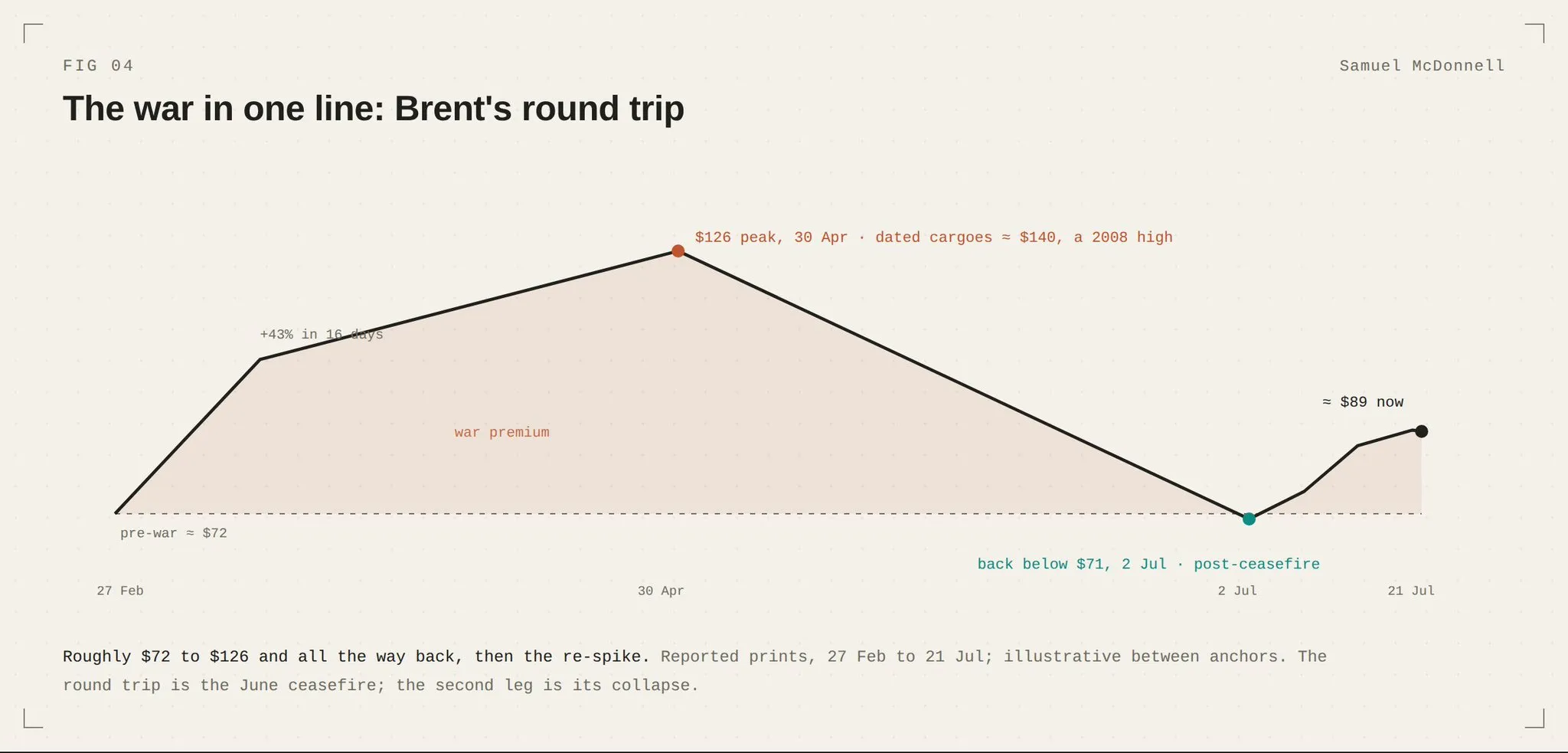
There is a control group for everything this piece claims about how this market prices shocks, because the United States has been at war with Iran since late February. Defence Secretary Pete Hegseth puts the cost at $37.5 billion so far. As I write, on 21 July, US strikes are into their tenth consecutive night, Iranian missiles have hit Kuwait, Bahrain and Jordan, and three American service members were killed in recent days. Brent crude tells the war’s whole story in one line: roughly $72 a barrel before the first strikes, up 43 per cent inside sixteen days, above $126 at the April peak with dated cargoes touching levels last seen in 2008, back below $71 in early July after the June ceasefire, and around $89 this week as the ceasefire collapsed, briefly clearing $90 when the troop deaths were confirmed.
Now look at what equities did across the same six months. The S&P 500 fell about ten per cent from its January peak to a low on 30 March, driven by the war, the oil spike and a run of nerves about AI valuations. Then it staged what one tracker called the fastest war-shock recovery on record, setting a fresh all-time high on 15 April, within fifty days of the first strikes, while the war was still running and the Strait of Hormuz was still blockaded. In mid-July it sat within one per cent of record highs, through the ceasefire’s collapse and a second oil surge.
The recovery was not priced on peace. It was priced on AI. From the March low, a fund tracking only the Magnificent Seven rose nearly 18 per cent while the rest of the index managed about 8.
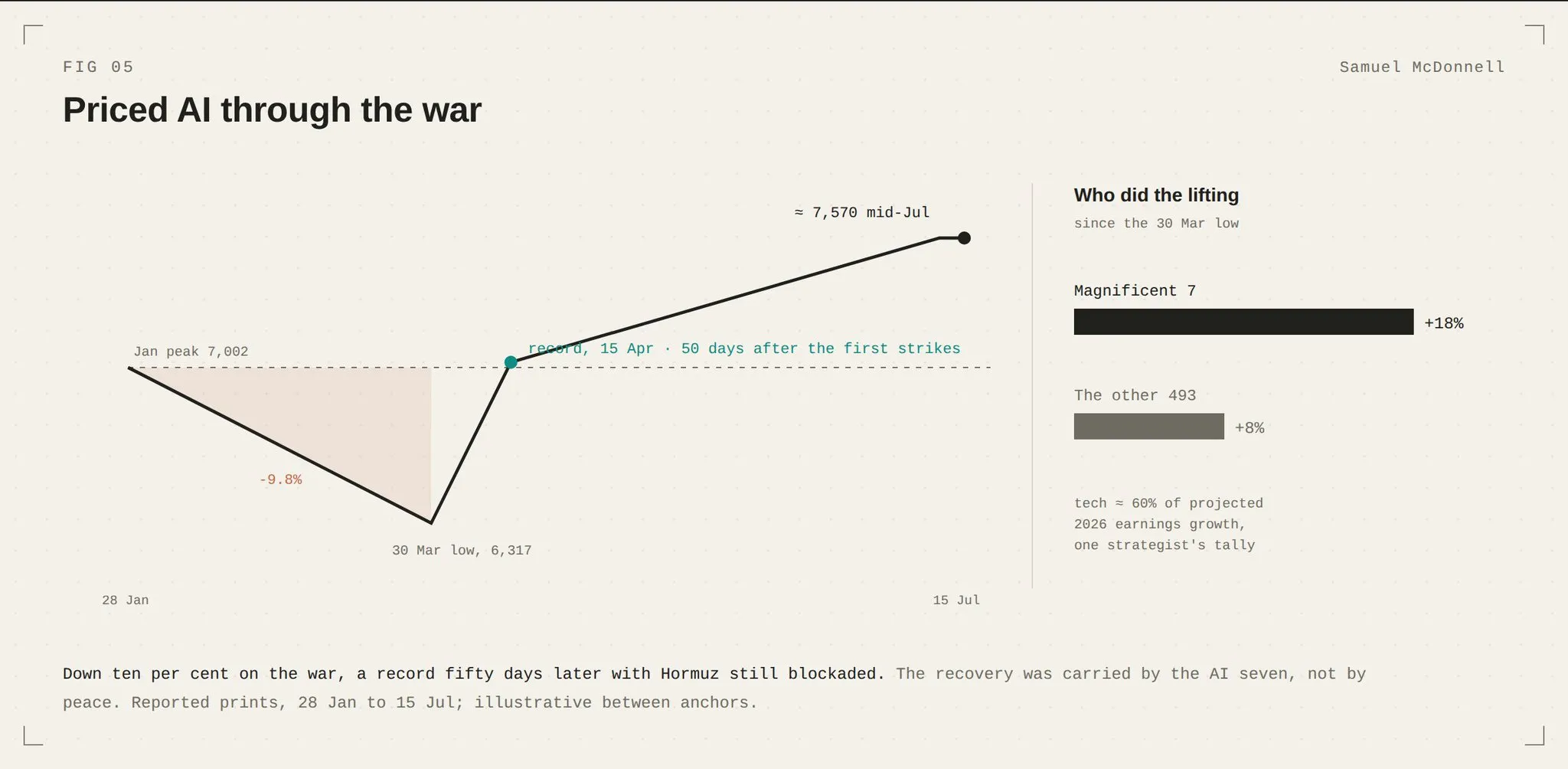 Tech was projected, by one strategist’s tally, to deliver roughly 60 per cent of the year’s earnings growth. Mark Zandi’s explanation was blunt: AI and tech stocks, a broader basket than the seven, are nearly half the index’s value and “run on their own dynamic independent of anything, including the war in Iran”. Ed Yardeni’s was blunter still: as far as the market was concerned, “the war is over until further notice”. By at least one sector tally, defence stocks underperformed through a shooting war, a break with eighty years of pattern. The index did not price the war. It priced AI through the war.
Read that both ways, because both readings are true. The bull reading is resilience: this market absorbed a $126 oil shock, a blockade and two rounds of escalation, and made new highs. The less comfortable reading is that the concentration is the anaesthetic. An index that is one-third AI can be hurt by an oil war for fifty days; it cannot stay hurt by anything except its own story. Which is exactly what makes the eventual test binary rather than gradual. The war showed that every shock except an AI shock gets bought. Kimi K3 aims at the only thing this market has demonstrated it feels, and there are no other seven names to hide in.
The macro channel is live too. The IMF cut its 2026 global growth forecast to 3.1 per cent and raised its inflation forecast to 4.4 per cent on the back of the war. The Fed has held rates at 3.50 to 3.75 per cent for four consecutive meetings and revised its 2026 inflation projection upward, and futures now price a live chance of a hike at the meeting on 28 and 29 July, the days directly after the weights drop. War-driven energy inflation is a large part of why, and tight money is the classic solvent for duration-heavy equity and for data centre credit priced off it. The one growth engine and the one war are bidding on the same two commodities, energy and money. Data centres bid up electricity from one side. Blockades bid up the fuels behind it, and the inflation prints behind those, from the other.
It also deflates the tempting geopolitical inversion, the idea that an administration expecting the bubble to burst might reach for a bigger war. Start with the chronology: the war predates the AI scare by five months, so the causality cannot run that way. The behaviour points the other way too. Trump floated a 20 per cent fee on shipping through Hormuz and then called it off after industry objections that it had no legal basis; whatever drove the climbdown, it is consistent with an administration that manages escalation around prices. The market’s own operating theory, the one traders shorthand as TACO, is that economic pain forces the White House to back down. An economy this levered to one trade is a leash on escalation, not a motive for it. The genuinely unpriceable war is elsewhere. The chips underwriting this entire capex cycle are fabricated overwhelmingly on one island off the Chinese coast. This index has shown it can recover from a Gulf war. Nobody should be eager to find out whether it can recover from a Taiwan one.
Beijing’s playbook
None of this is accidental. Denied top-end chips by export controls, Chinese labs were forced into efficiency and chose open weights as the distribution strategy. The parallel is electric vehicles: the state built the ecosystem, subsidised the inputs, let a brutal domestic knife-fight pick the winners, and then exported them at prices the protected incumbents could not meet.
Xi Jinping made the strategy explicit the day after K3 launched. In his first keynote at the World AI Conference in Shanghai, he called on countries to “encourage open source, openness, collaboration and sharing”, announced 5,000 AI training places for developing countries, and launched a China-headquartered global AI governance body with 29 founding states, a direct rival to Washington’s Pax Silica bloc. Open weights are industrial policy and foreign policy in one artefact. You cannot tariff a download, and it is hard to litigate dumping when the price is zero.
What a ban would actually do
Weights are files. Once K3’s checkpoint publishes on 27 July, it exists on hard drives worldwide and prohibition becomes unenforceable at the artefact level. Real policy would have to work on usage: barring federal contractors, Entity List designations, advisories, liability. Large US corporates would comply. Startups, researchers and the entire rest of the world would route around it.
The good-faith security case deserves stating before it gets dismissed. Moonshot itself concedes K3 is not at the frontier, which is exactly why open-weighting it carries little cyber risk today. The harder problem arrives with the next release: a genuinely frontier Chinese model, open-weighted with real offensive cyber capability, landing after the world’s default stack has already been built on Chinese weights. That dependency would be painful to unwind, and it is the argument serious security people actually make. It is also an argument about a future model, and it points at usage-level controls. A ban on this one answers neither.
Which leaves the likelier outcome: a protected home market for two trillion-dollar labs. There is no honest way to describe that except as a bailout, and it carries the Detroit lesson. Protection preserved the American car industry at home and cost it the world, while BYD lapped it everywhere else. Run the same play at the model layer and American labs keep their most lucrative customers while the global default stack quietly becomes Chinese.
What to watch
27 July, first. The weights land and independent evaluation of the artefact finally becomes possible. If K3 verifies, the story hardens. If it does not, remember which headlines ran three weeks early.
The Q2 GDP advance estimate, second. It is the first test of whether the capex pace held through spring, and of how much American growth exists without it.
The IPO pricing, third. SpaceX’s June debut opened the window. Whether public markets will pay private-round multiples for negative-margin token sellers entering a price war is the most consequential valuation question of the year.
Microsoft’s router, quietly. Workload migration will not be announced. It will show up in inference bills.
And Brent, always. At around $89 with the strait contested, crude is the market’s running estimate of how long this war lasts, and the AI trade’s discount rate is downstream of it. The Fed meets the day after the weights land.
A leaderboard is a strange thing for a superpower to be leveraged to, and of course it was never truly the leaderboard. The exposure was built at home over three years, one capex guidance raise at a time, then concentrated into seven tickers and two S-1s. Kimi K3 did not create that fragility. It priced it.
Sources
- Moonshot AI Kimi K3 release and specifications: VentureBeat, Tom’s Hardware, Bloomberg (16-17 July 2026)
- “China just erased America’s AI lead”: Axios (17 July 2026)
- Arena Frontend Code leaderboard: Arena.ai announcement on X; The Decoder and Epoch AI on FrontierMath Tier 4
- Artificial Analysis Intelligence Index: artificialanalysis.ai
- White House deliberations: Axios (20 July 2026), via Tom’s Hardware and Daily Caller coverage
- Dean Ball essay and David Sacks response: Futurism (20 July 2026)
- Anthropic lead estimate (Tarun Chhabra): via BigGo Finance aggregation; primary pending verification
- Chamath Palihapitiya posts: @chamath on X (18-21 July 2026)
- Microsoft Kimi K3 evaluation: The Information (20 July 2026)
- Pricing: Moonshot platform pricing; Fortune; OrcaRouter early testing (directional)
- OpenRouter token share: Wall Street Journal (17 July 2026)
- Xi Jinping WAIC keynote: SCMP, Quartz, WSJ (17 July 2026)
- The security steelman: Transformer (17 July 2026)
- Magnificent Seven concentration: The Motley Fool, Forbes (July 2026)
- Hyperscaler capex: TrendForce (May 2026 revision); Data Center Frontier
- Q1 2026 GDP decomposition: BEA advance and third estimates; Beta Finch and Epoch AI analyses
- Data centre credit: Quinn Emanuel client alert (March 2026); FT via Cryptopolitan on SPVs; Global Data Center Hub Q2 2026 roundup (Oracle-backed debt repricing); Bisnow on the Meta/Blue Owl vehicle
- Valuations, revenue and S-1 filings: CNBC, Fortune, TechCrunch, IG, OpenAI announcement (May-June 2026)
- Iran war status, costs and Hormuz measures: CNN, Al Jazeera and CBS News live coverage (July 2026); Hegseth testimony via CNN and CBS
- Oil price path: Al Jazeera (2, 8 and 14 July 2026), CNBC and Bloomberg (20 July 2026), Trading Economics
- Equity path through the war: CNN, NBC News, CNBC and Yahoo Finance (April 2026); Kobeissi Letter (July 2026); StockCram sector tally (April 2026, single source)
- IMF 2026 forecasts: via NBC News (April 2026)
- Fed rate path: Trading Economics (March 2026); July 2026 meeting expectations via market-analysis aggregators, FOMC materials pending sight-check
- DeepSeek January 2025 precedent: contemporaneous market coverage